The Roman Empire fell more than 1,500 years ago, but there are many Roman inventions we still use today. In many ways, we are still living in a world the Romans built. Every time you drive on a paved road, open a book, check the date or turn on a tap, you are using ideas that Roman engineers, rulers and thinkers developed or perfected.
The Romans did not invent everything they are famous for. They were brilliant at borrowing ideas from the Greeks, Etruscans and others, then improving them and spreading them across a huge empire. Here are ten Roman inventions we still use today, and the stories behind them.
1. Roman concrete
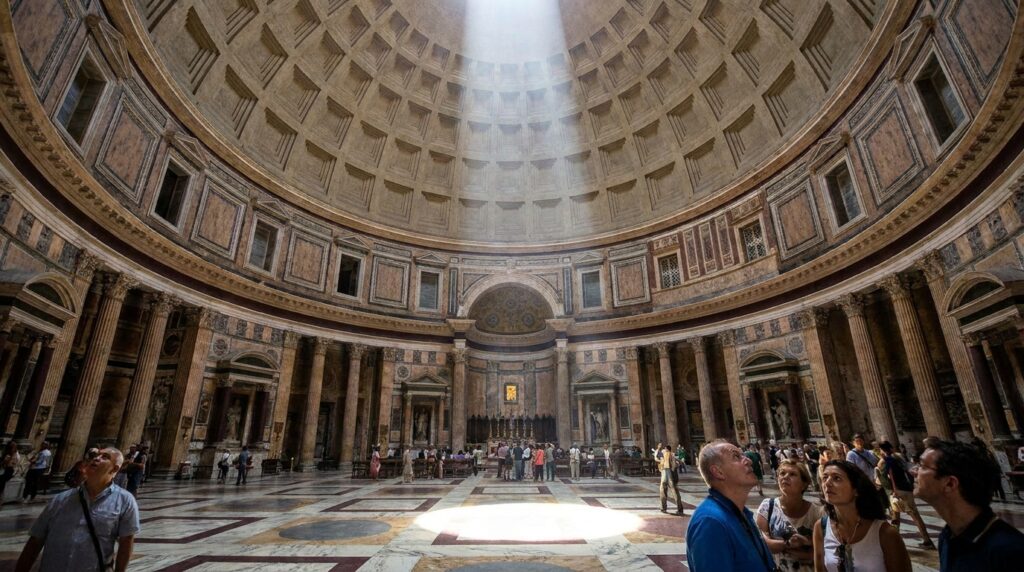
Concrete is everywhere in modern cities, and the Romans were true masters of it. They mixed lime with volcanic ash and rock to create a material that was strong, durable and could even set underwater, which made it perfect for harbors and bridges.
The greatest example is the Pantheon in Rome, completed around 126–128 AD. Its enormous dome, about 43 meters across, is still the largest unreinforced concrete dome in the world, nearly 2,000 years after it was built. Scientists continue to study Roman concrete today to understand why some of it has lasted so well and how its secrets could make modern buildings more durable.
2. Roads and highways
The famous saying “all roads lead to Rome” was not far from the truth. By around 200 AD, the Romans had built more than 50,000 miles of paved roads across their empire, along with a much larger network of smaller routes.
Roman roads were carefully engineered in layers of soil, gravel and stone, with a curved surface so rainwater would drain off to the sides. They were remarkably straight, which made it possible for soldiers to march long distances quickly. Milestones and signposts showed travelers how far they had to go, an idea that lives on in every road sign you see today. Some Roman roads, like the Appian Way, can still be walked on.
3. Aqueducts and running water
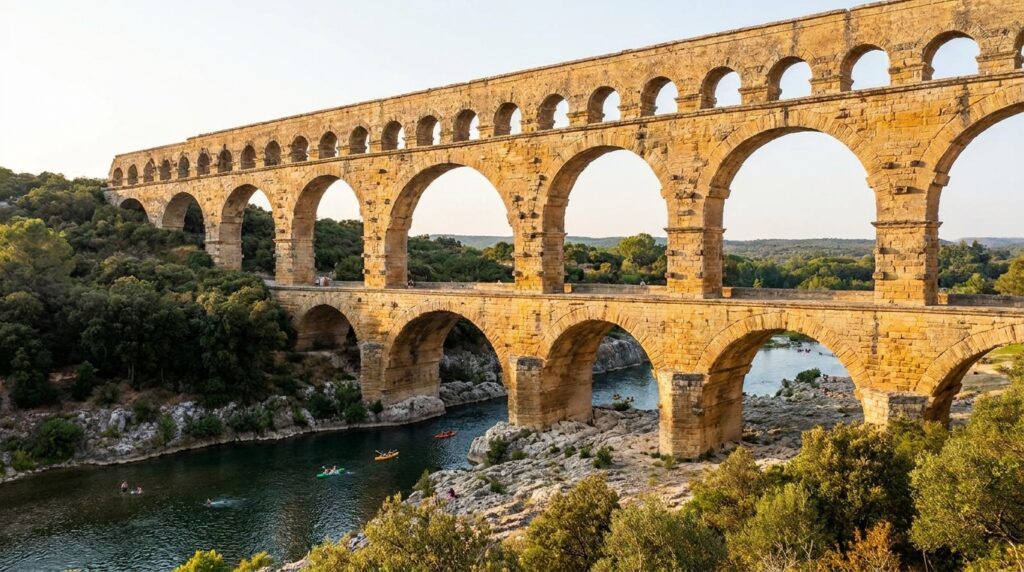
Getting clean water to a growing city is a huge challenge, and the Romans solved it with aqueducts. The first Roman aqueduct was built around 312 BC. These systems used gravity, carefully calculated slopes, tunnels and bridges to carry water from distant springs into towns.
At its height, the city of Rome was supplied by 11 aqueducts that fed public fountains, baths and the homes of the wealthy. One of the most famous examples, the Pont du Gard in southern France, still stands today. In Rome, the famous Trevi Fountain is still fed by a restored version of an ancient aqueduct, the Aqua Virgo.
4. Sewers and sanitation
Along with bringing clean water in, the Romans also built systems to carry dirty water out. The Cloaca Maxima, one of the world’s earliest sewer systems, drained the marshy land of Rome and carried waste into the River Tiber.
Roman cities had public latrines, drainage channels and connected sewer lines. Their approach to public hygiene was far ahead of many later societies, and the basic idea of underground drainage is still at the heart of modern city planning.
5. Arches and domes
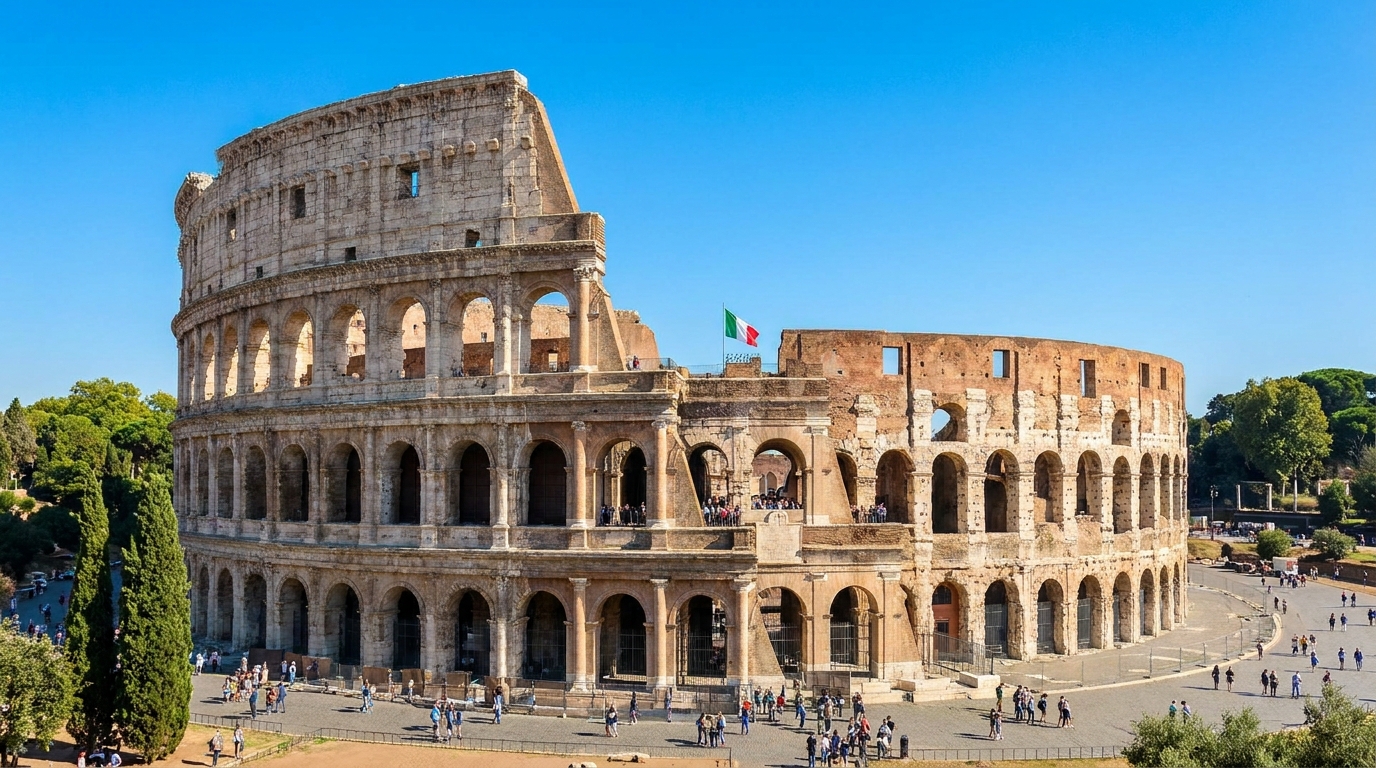
The arch was not a Roman invention, but the Romans used it on a scale nobody had seen before. Arches allowed them to build bridges, aqueducts, huge public buildings and triumphal monuments that were both stronger and more spacious than earlier designs.
By combining arches with concrete, they could create vaults and domes that covered large open spaces. You can see the influence of Roman arches in train stations, cathedrals, stadiums and bridges around the world today.
6. The bound book (codex)
For centuries, people in the ancient world wrote long texts on scrolls, which could be several meters long and awkward to read. The Romans helped popularize the codex, a stack of pages bound together on one side, the ancestor of the modern book.
The codex was easier to carry, protect and store, and it made it much simpler to jump to a specific page. Early Christians adopted it widely for copies of religious texts, and over time it replaced the scroll completely. Every book on your shelf follows the same basic design.

7. The first newspapers
Long before printing presses, ancient Rome had a kind of official news bulletin called the Acta Diurna, meaning “daily acts.” Dating back to at least 131 BC, it recorded important events such as government decisions, trials, births, deaths and public announcements.
These notices were displayed in busy public places like the Forum so that citizens could read them. In 59 BC, Julius Caesar ordered that the proceedings of the Senate also be published. The idea of sharing daily news with the public lives on in every newspaper, news website and news app today.
8. The Julian calendar
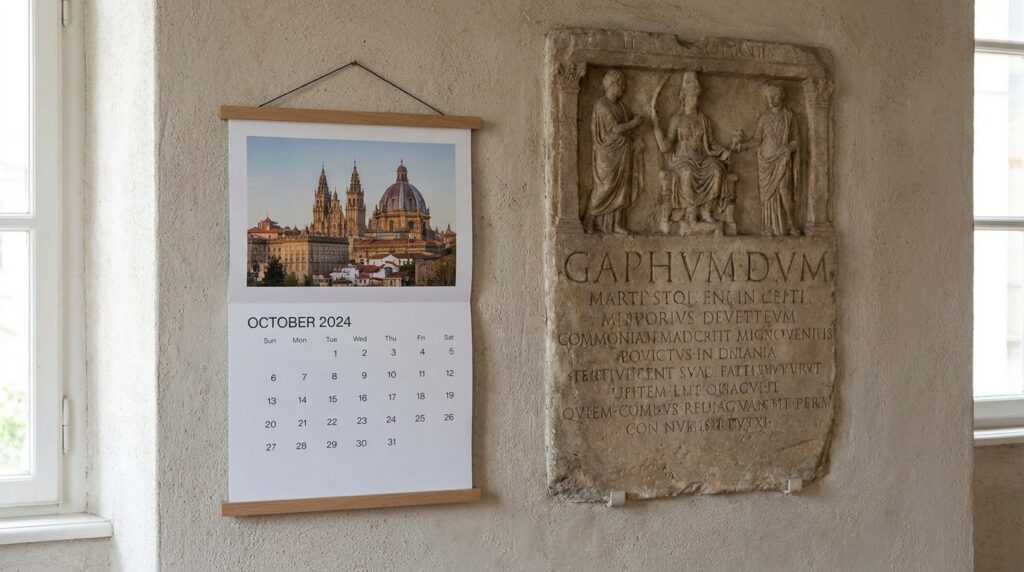
The calendar you use every day has Roman roots. In 46 BC, Julius Caesar introduced a new calendar, now called the Julian calendar, to fix the confusion of the older Roman calendar. It had 365 days in a year, with an extra day added every four years, the idea we still know as a leap year.
The modern Gregorian calendar, introduced in 1582, is a small adjustment of Caesar’s system. Even the names of some months, such as July (named after Julius Caesar) and August (named after the emperor Augustus), come straight from Rome.
9. Surgical tools and field medicine
Roman doctors used a surprising range of surgical instruments, including scalpels, forceps, bone saws and specialized hooks. Many of these tools changed very little for centuries afterward, and their basic shapes are still recognizable in hospitals today.
The Roman army also had organized medical care for soldiers, with field hospitals and trained medics. Some Roman doctors boiled their instruments in hot water before use, an early step toward the idea of sterilization.
10. Underfloor heating
Many modern homes have heated floors, but the Romans had their own version 2,000 years ago, called the hypocaust. Floors were raised on stacks of small pillars, and hot air from a furnace flowed through the space underneath, warming the room above. Hollow channels in the walls carried heat upward to other floors.
Hypocausts were expensive, so they were mostly found in public baths and the homes of wealthy families. But the idea of heating a building from below is very much alive today.
Why Roman inventions we still use today matter
From the roads we travel on to the books we read and the dates we write, ancient Rome is still all around us. The Romans were not only great conquerors but also practical problem-solvers who built systems meant to last. The Roman inventions we still use today prove that a good idea can survive for thousands of years.
The next time you walk across a bridge, open a book or mark your birthday on the calendar, take a moment to remember the engineers, writers and rulers of ancient Rome. Their ideas have been quietly shaping the world for more than two thousand years.
You might also like
Want more? Browse all our History stories.
Sources
- 10 Ancient Roman Inventions That Shaped the Modern World – History Hit
- Ancient Roman Inventions That Are Still Used Today – WorldAtlas
Frequently asked questions
What did the Romans invent that we still use today?
We still use many Roman innovations, including concrete, paved roads, aqueducts, sewers, bound books, public news bulletins, the Julian calendar’s leap year and underfloor heating.
Did the Romans invent concrete?
The Romans perfected concrete by mixing lime with volcanic ash. The Pantheon’s dome, completed around 126 to 128 AD, is still the largest unreinforced concrete dome in the world.
Did the Romans invent the calendar we use?
Our calendar comes from the Julian calendar, which Julius Caesar introduced in 46 BC. The Gregorian calendar of 1582 is a small adjustment of it.
How many aqueducts did ancient Rome have?
At its height, the city of Rome was supplied by 11 aqueducts. The Trevi Fountain is still fed by a restored ancient aqueduct, the Aqua Virgo.
Save this for later