
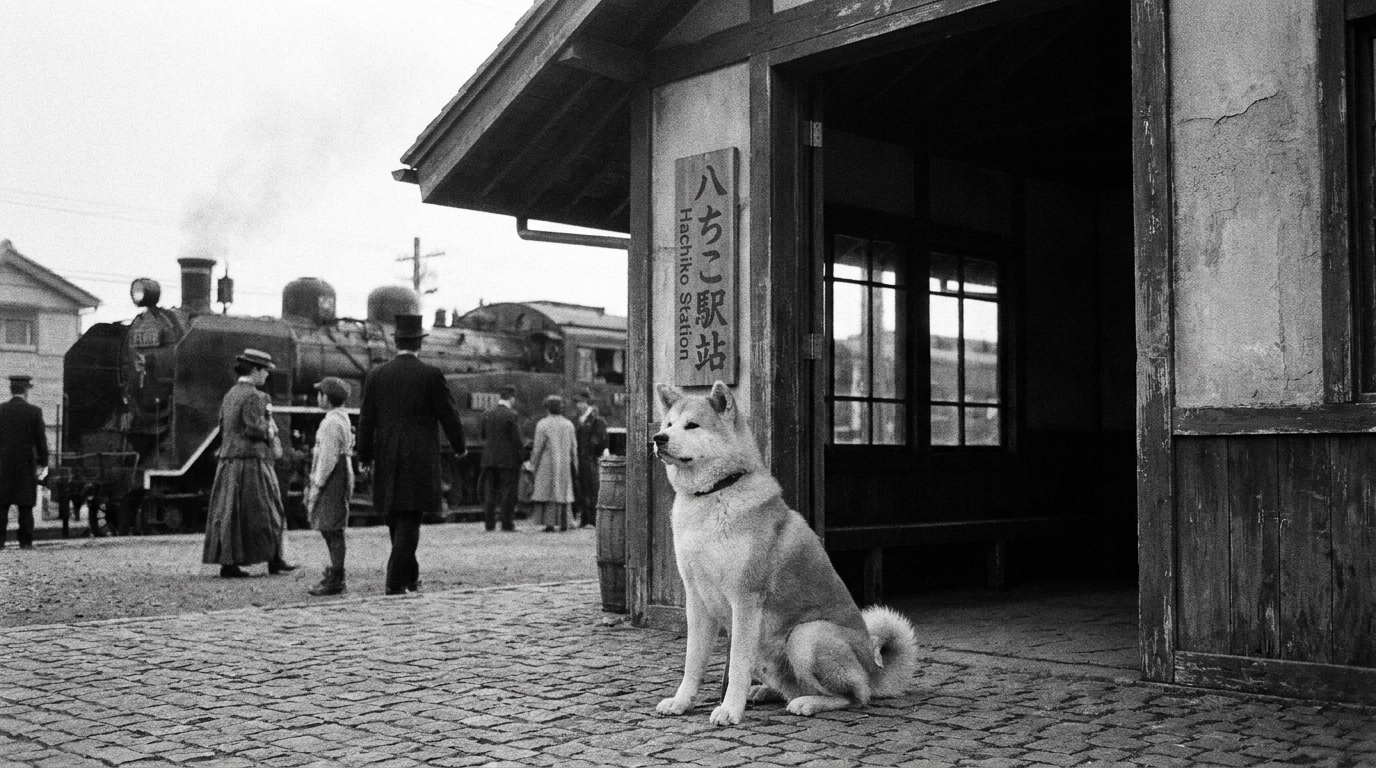
The Hachiko true story sounds almost too sweet to be real. A dog who walks to a train station every afternoon to meet his owner, and keeps going back for almost ten years after the owner has died, feels like something a screenwriter would invent. But the story of Hachiko is real, and it happened in Tokyo nearly a century ago.
Today, Hachiko is one of the most famous dogs in the world. His bronze statue outside Shibuya Station is a meeting point for thousands of people every day, and his story has inspired books, festivals and two major films. Here is the Hachiko true story: what actually happened, what is myth, and why the little Akita from northern Japan still makes people cry.
A puppy from the snowy north
Hachiko was born in November 1923 on a farm near the city of Odate, in Akita Prefecture, in the north of Japan’s main island. He was an Akita, a large, thick-coated breed known for being calm, dignified and fiercely devoted to its family.
In early 1924 the puppy was sent to Tokyo to live with Hidesaburo Ueno, a professor of agriculture at Tokyo Imperial University (now the University of Tokyo). Ueno was a respected scientist and a pioneer of agricultural engineering in Japan. He was also a dog lover, and he named the new puppy Hachi. The extra “ko” was added later as a sign of affection, a little like calling someone “dear Hachi.”
The daily walk to Shibuya Station
Ueno lived in the Shibuya area and commuted to work by train. Every morning, Hachi walked with him to Shibuya Station. Every afternoon, the dog went back to the station and waited for the professor’s train to arrive, then the two of them walked home together.
For a little over a year, this was simply their routine. Station workers and shopkeepers got used to seeing the big cream-colored dog sitting near the ticket gates, watching the crowd for one familiar face.
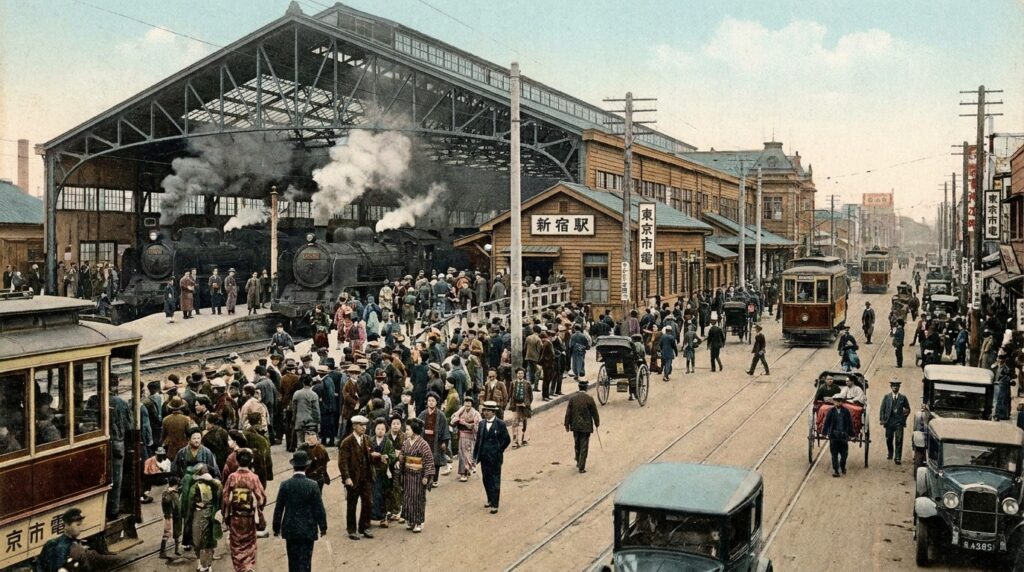
The day the professor did not come home
On May 21, 1925, Professor Ueno suffered a sudden brain hemorrhage while he was at work. He died that day and never returned to Shibuya Station.
Hachiko waited for him that afternoon, as usual. The professor did not appear. The next day, the dog went back and waited again. And the day after that.
After Ueno’s death, Hachiko was passed between several homes, including relatives of the family and later the household of Ueno’s former gardener, who lived near Shibuya. No matter where he stayed, the dog kept finding his way back to the station in the late afternoon, around the time the professor’s train used to arrive.
Nearly ten years of waiting
Hachiko kept up this habit for about nine years and nine months. In the beginning, not everyone was kind to him. Some station staff chased him away, and a few people treated the stray-looking dog badly.
That changed in 1932. A former student of Ueno’s, Hirokichi Saito, who was researching the Akita breed, recognized the dog and learned his story. Shortly afterward, the Asahi Shimbun, one of Japan’s biggest newspapers, published an article about the faithful dog at Shibuya Station.
Almost overnight, Hachiko became a national celebrity. People traveled to Shibuya just to see him. Visitors brought him food and treats, and teachers used his story to talk to children about loyalty and devotion.
A statue while he was still alive
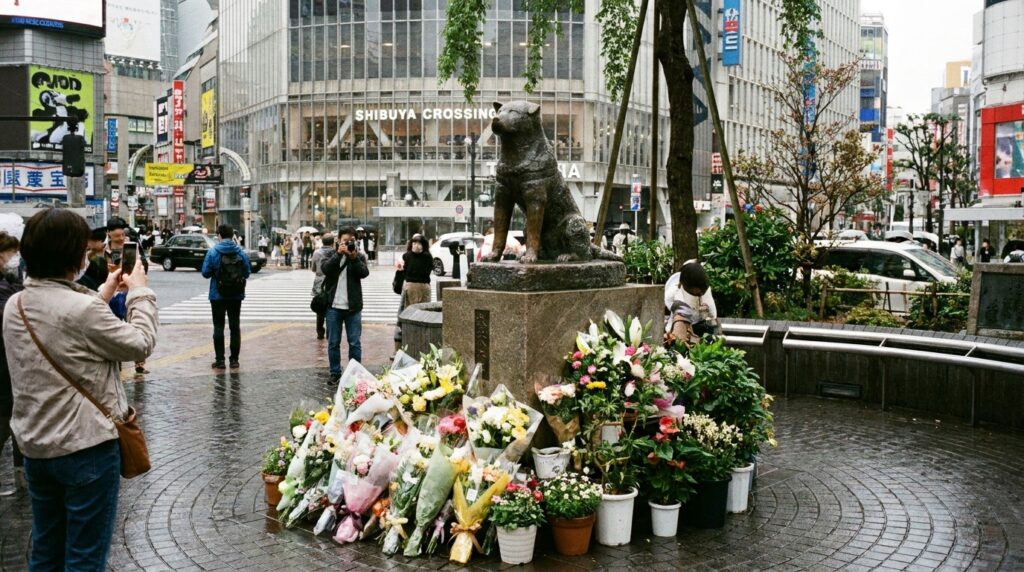
In April 1934, something unusual happened: a bronze statue of Hachiko was unveiled at Shibuya Station while the dog was still alive. It was made by the sculptor Teru Ando, and Hachiko himself was present at the ceremony.
Sadly, that first statue did not survive. During the Second World War, it was melted down for the war effort, like many metal objects across Japan at the time. In 1948, a new bronze statue was made by Takeshi Ando, the son of the original sculptor. That second statue is the one that still stands outside Shibuya Station today.
Hachiko’s death in 1935
On March 8, 1935, Hachiko was found dead on a street in Shibuya. He was 11 years old. For many years, people argued about the cause, and a popular rumor claimed he had swallowed yakitori skewers given to him by visitors.
Modern research has given a clearer answer. Scientists who examined his preserved organs in 2011 found that he had terminal cancer and a heartworm infection. The skewers found in his stomach did not cause his death.
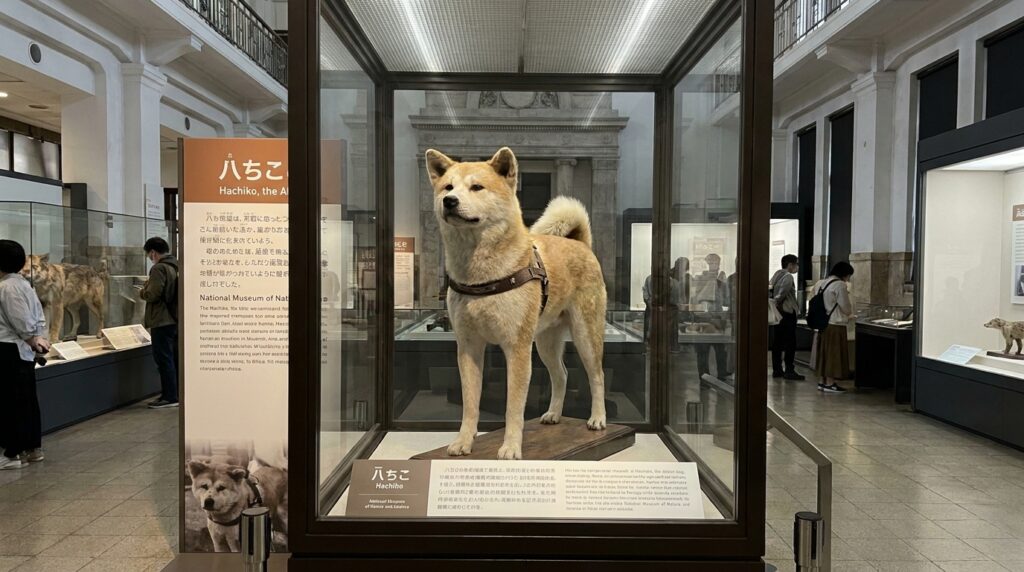
Hachiko’s death was front-page news, and a large memorial service was held for him. Parts of his body were preserved, and his mounted pelt is still on display at the National Museum of Nature and Science in Ueno Park, Tokyo. Some of his remains were also placed beside Professor Ueno’s grave in Aoyama Cemetery, so the two were finally together again.
Myths vs. facts
Because the Hachiko true story is so famous, some details have been exaggerated over time. Here are a few common questions:
- Did Hachiko wait every single day? Records suggest he returned almost daily, but he was not chained to the station. He lived with caretakers and walked to Shibuya in the afternoons.
- Was he a stray? No. He always had people looking after him, even if he sometimes looked scruffy and was treated like a stray by strangers.
- Did he die at the station? He was found dead on a street in Shibuya, not inside the station itself.
- Is his birthday known? Not exactly. He was born in mid-November 1923, and November 10 is often used as his birthday.
How the world remembers Hachiko
The Hachiko true story has never stopped spreading. In 1987, the Japanese film Hachiko Monogatari brought the story to cinemas across Japan. In 2009, the American film Hachi: A Dog’s Tale, starring Richard Gere, retold it in a small New England town and introduced the loyal Akita to a whole new generation around the world.
Every year on March 8, people gather at Shibuya Station for a remembrance ceremony. His hometown of Odate also honors him with statues near its station, and the city has become a place of pilgrimage for Akita lovers.
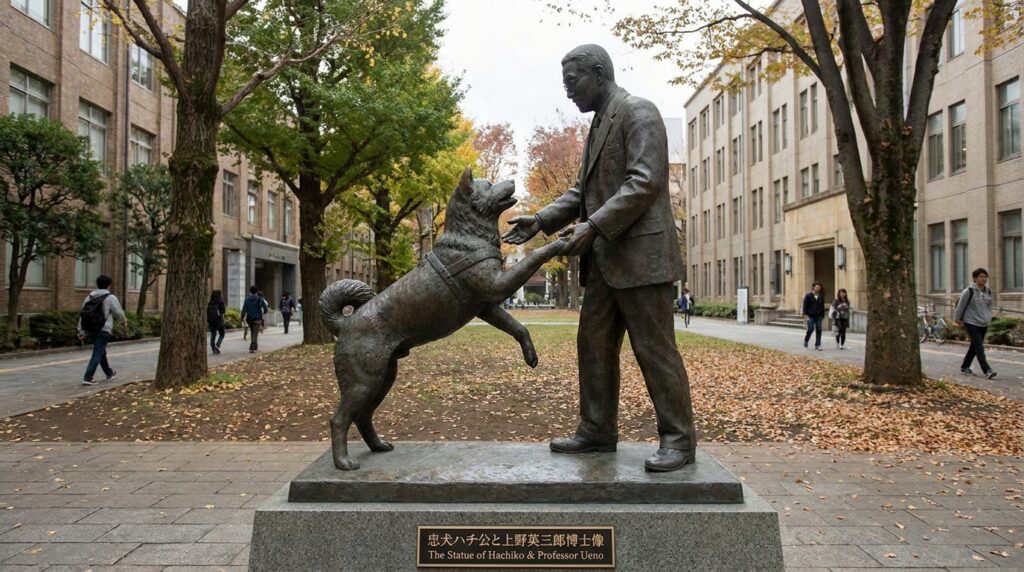
In 2015, the University of Tokyo, where Professor Ueno once taught, unveiled a touching new statue on its campus. It shows Hachiko jumping up joyfully to greet the professor. After nearly ten years of waiting at the station, the dog and his owner were finally reunited, at least in bronze.
Why the Hachiko true story still matters
Part of the reason Hachiko still moves people is that his loyalty asked for nothing in return. He did not understand death, trains or newspapers. He only knew that the person he loved used to come home on the afternoon train, and he refused to stop hoping.
Dog owners everywhere recognize a little of their own pets in him: the dog who waits by the door, who knows the sound of your car, who greets you as if you had been gone for years. Hachiko simply showed that devotion on a scale few of us can imagine.
If you ever visit Tokyo, take a moment at Shibuya Crossing to stand by the small bronze dog that so many people walk past every day. Behind that statue is the Hachiko true story, one of the most beautiful stories of love and loyalty ever told.
Frequently asked questions
Is the story of Hachiko true?
Yes. Hachiko was a real Akita who lived in Tokyo. After his owner, Professor Hidesaburo Ueno, died suddenly in May 1925, Hachiko kept returning to Shibuya Station almost every day for about nine years and nine months.
How long did Hachiko wait for his owner?
Hachiko waited for about nine years and nine months, from Professor Ueno’s death in May 1925 until his own death on March 8, 1935.
How did Hachiko die?
Hachiko died on March 8, 1935, at age 11. Scientists who examined his preserved organs in 2011 found he had terminal cancer and a heartworm infection.
Where is the Hachiko statue?
The best-known Hachiko statue stands outside Shibuya Station in Tokyo. Another statue, unveiled in 2015 at the University of Tokyo, shows Hachiko greeting Professor Ueno.
Save this for later

You might also like
Want more? Browse all our Animals stories.