
There are hidden details in famous paintings that even art lovers walk straight past. Some of these works have been studied for hundreds of years, yet they still reveal new secrets. Artists loved to hide small jokes, symbols and secrets in their work, and modern technology like infrared cameras and X-ray scans keeps revealing new layers underneath the paint.
Some of these hidden details are confirmed facts. Others are fascinating theories that experts still argue about. Here are ten of the most surprising hidden details in famous paintings, and what you should look for the next time you see them.
1. The Arnolfini Portrait – Jan van Eyck (1434)
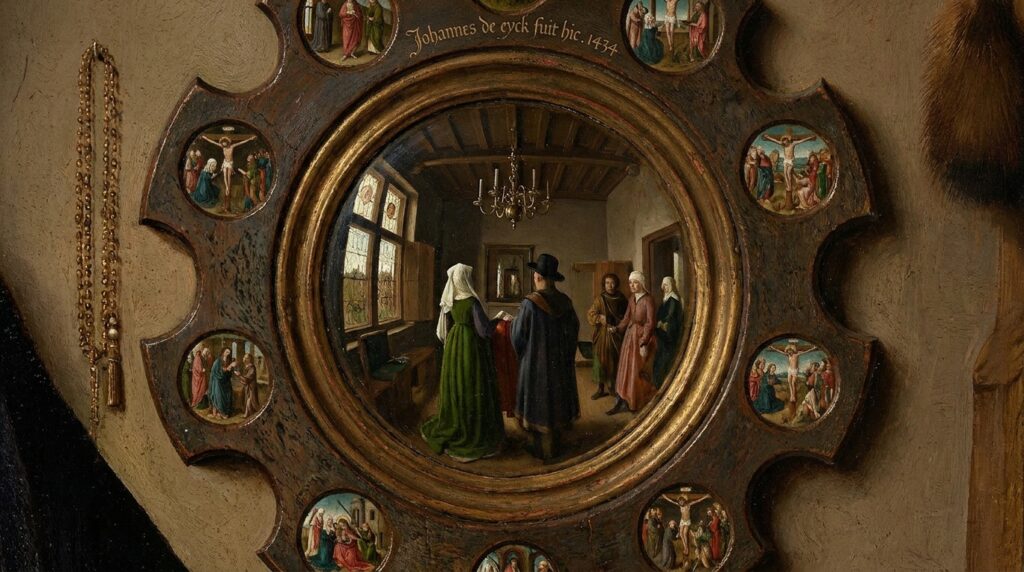
At first glance, this painting shows a wealthy couple standing in a richly decorated room in Bruges. But look at the round convex mirror on the back wall. Reflected in it are the couple from behind and two more figures standing in the doorway, people who are not visible anywhere else in the scene. Many art historians believe one of them is the artist himself.
Above the mirror, van Eyck added an elegant Latin inscription that translates to “Jan van Eyck was here, 1434.” It works almost like a signature and a witness statement at the same time. Another surprise: the woman is often assumed to be pregnant, but experts say her rounded shape simply reflects the fashion of the time, with heavy, gathered fabric.
2. The Ambassadors – Hans Holbein the Younger (1533)
This double portrait of two French diplomats is full of carefully painted objects: globes, books, scientific instruments and a lute with a broken string. But the strangest detail is the long, grey smear stretched across the floor at the bottom of the painting.
Viewed from the front, it looks like a mistake. But if you stand off to the right side and look at it at a sharp angle, the shape transforms into a human skull. This technique is called anamorphosis. The skull is a memento mori, a reminder that death comes for everyone, no matter how rich or powerful they are. The painting hangs in the National Gallery in London, where visitors often walk to the side to see the trick for themselves.
3. The Creation of Adam – Michelangelo (around 1511)
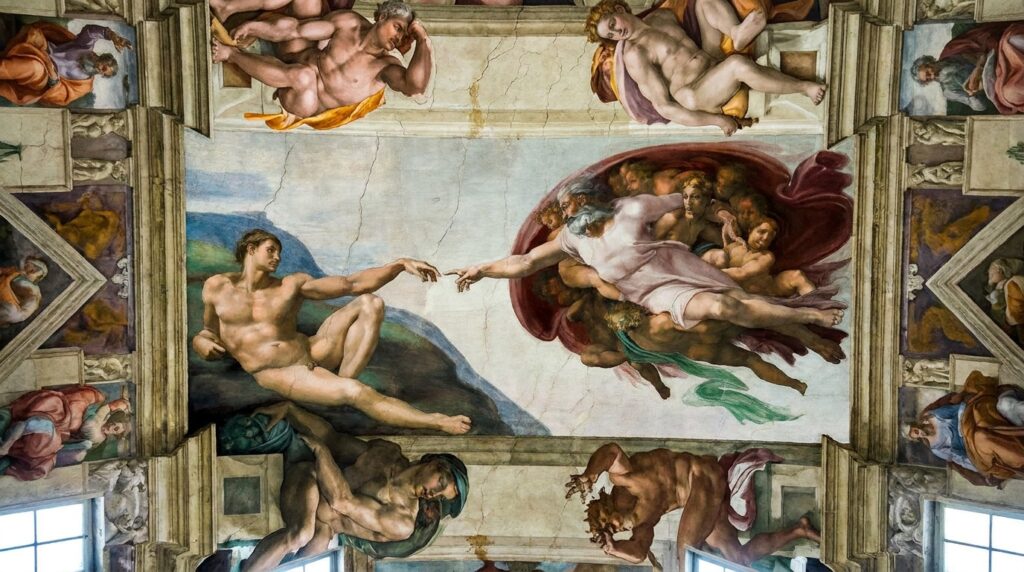
Michelangelo’s famous scene on the Sistine Chapel ceiling shows God reaching out to give life to Adam. In 1990, a doctor named Frank Meshberger published a paper pointing out that the shape around God and the angels looks remarkably like a cross-section of the human brain.
Michelangelo is known to have studied human anatomy by dissecting corpses, so some experts think the resemblance may be intentional, perhaps showing that God is giving Adam intelligence as well as life. Others think it is simply a coincidence. Either way, once you see the brain, it is very hard to unsee.
4. The Last Supper – Leonardo da Vinci (around 1498)
Leonardo’s mural in Milan has inspired countless theories, many of them made famous by novels and films. One of the more interesting ideas came from an Italian musician and computer technician, Giovanni Maria Pala, in 2007. He suggested that if you draw the five lines of a music staff across the painting, the positions of the hands and bread rolls can be read as musical notes, creating a short, slow piece of music.
There is no proof that Leonardo planned this, but he was a skilled musician as well as a painter and inventor, which makes the idea fun to think about.
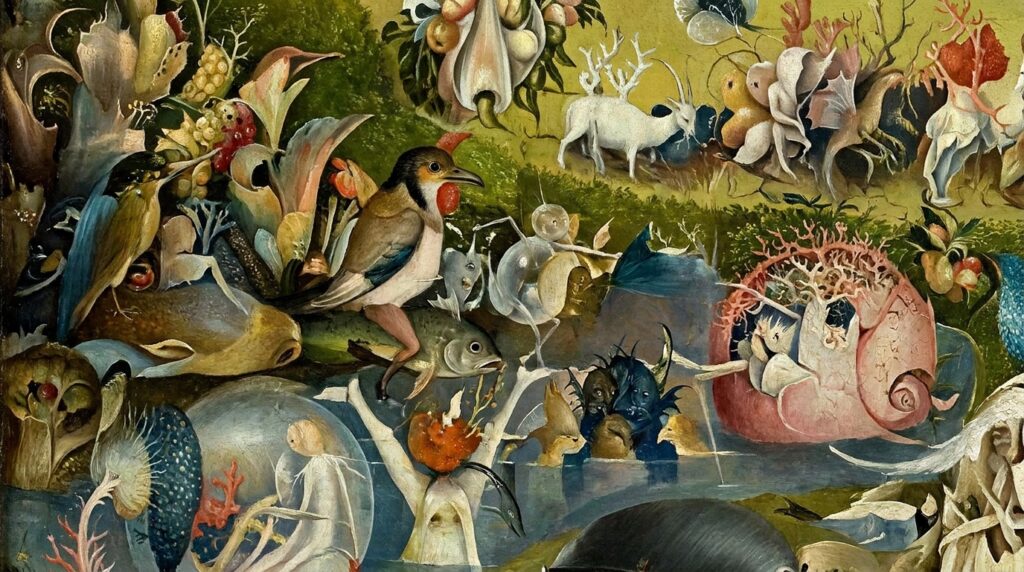
5. The Garden of Earthly Delights – Hieronymus Bosch (around 1490–1510)
Bosch’s huge, dreamlike triptych is packed with bizarre creatures and surreal scenes. In the right-hand panel, which shows a nightmarish vision of hell, one unlucky figure has a line of music painted across his backside.
In 2014, a college student transcribed the notes and played them, and the short tune spread across the internet as the “butt song from hell.” It is one of the funniest hidden details in famous paintings anywhere, and a good reminder that old masters had a sense of humor too.
6. Patch of Grass – Vincent van Gogh (1887)
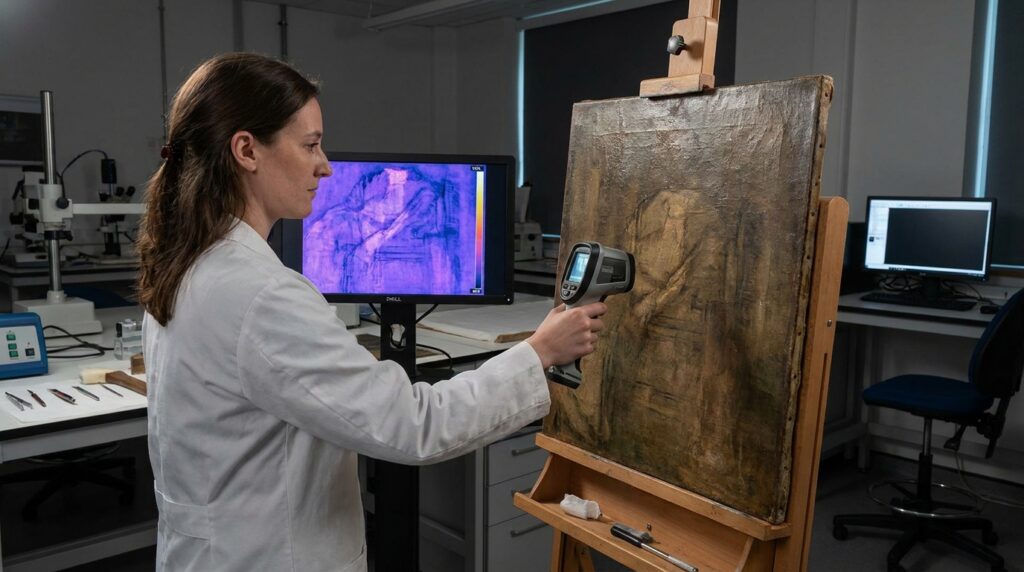
Van Gogh was often short of money, so he regularly reused old canvases and painted over his earlier work. In 2008, researchers used advanced X-ray techniques to look beneath this painting of a simple patch of grass. Hidden underneath, they found the face of a peasant woman that van Gogh had painted years earlier.
Experts believe that a large share of his early paintings may have other compositions hidden beneath the surface. Every scan has the potential to reveal a “new” van Gogh that nobody has seen for more than a century.
7. The Old Guitarist – Pablo Picasso (1903–1904)
This famous painting from Picasso’s Blue Period shows a thin, elderly musician hunched over his guitar. Look carefully behind his neck and you can sometimes spot faint shapes that don’t belong to the guitarist at all.
Infrared and X-ray studies have revealed that Picasso painted over an earlier image, including the figure of a woman. Like van Gogh, the young Picasso could not always afford new canvas, so he painted over his own work.
8. Madame X – John Singer Sargent (1883–1884)
Today, this elegant portrait of Virginie Amélie Avegno Gautreau hangs in the Metropolitan Museum of Art in New York. But when it was first shown in Paris in 1884, it caused a scandal.
In the original version, one of the jeweled straps of her black dress had slipped off her shoulder. Viewers found it far too suggestive. Sargent later repainted the strap back into place, and the painting was given the more anonymous title “Madame X” to protect the model’s reputation. The scandal hurt Sargent’s career in Paris, and he soon moved to London.
9. Lady with an Ermine – Leonardo da Vinci (around 1490)
This portrait of a young woman holding a white, weasel-like animal is one of only a handful of surviving portraits by Leonardo. Using a special multispectral scanning technique, French engineer Pascal Cotte found that the painting went through several versions.
In the first version, there was no ermine at all. The animal was added later, possibly as a clever reference to the Duke of Milan, who used the ermine as one of his symbols. It is a great example of how a painting can change while the artist is still working on it.
10. Mona Lisa – Leonardo da Vinci (early 1500s)
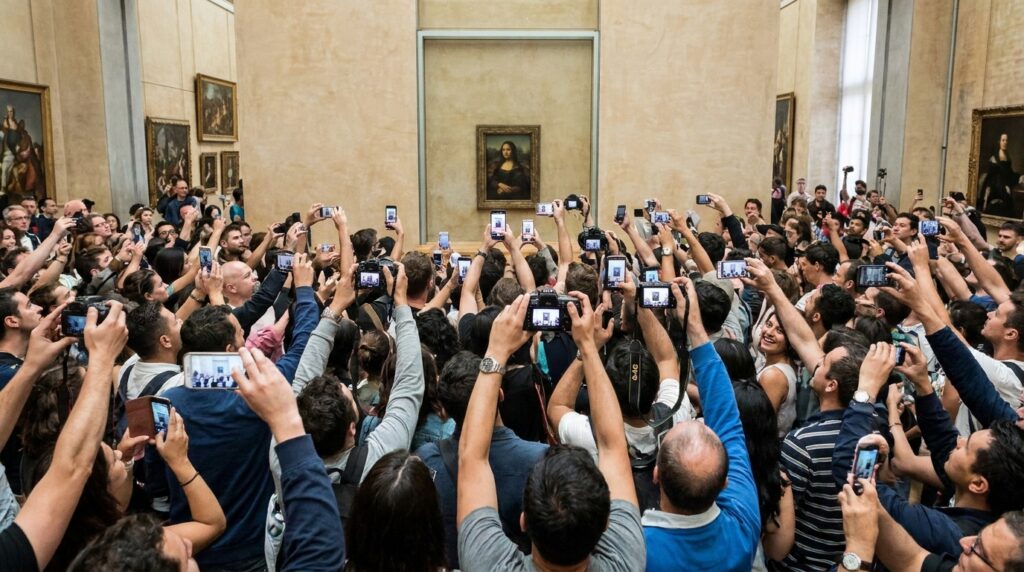
No list of hidden secrets would be complete without the Mona Lisa. In 2010, Italian researcher Silvano Vinceti claimed that tiny letters and numbers could be seen in her eyes when the painting was viewed under magnification.
Many art experts are skeptical and believe these marks may simply be cracks in the old paint. Still, the claim made headlines around the world and shows just how closely people study every millimeter of this famous face.
Why artists put hidden details in famous paintings
Artists hid things in their paintings for many reasons. Some were showing off their technical skill, like Holbein’s stretched skull. Some were making a statement about life and death, faith or power. Others were simply saving money by reusing canvases, never imagining that scientists centuries later would peer underneath the paint.
The next time you visit a museum, slow down and look at the corners, the reflections and the backgrounds. Great artists rarely put anything in a painting by accident, and you might just spot new hidden details in famous paintings for yourself.
Frequently asked questions
What is the hidden skull in The Ambassadors painting?
In Hans Holbein the Younger’s The Ambassadors (1533), the grey shape at the bottom becomes a human skull when you view it from the right side. It is a memento mori, a reminder of death.
What is hidden in the mirror of the Arnolfini Portrait?
The round mirror in Jan van Eyck’s Arnolfini Portrait (1434) reflects the couple from behind and two more figures in the doorway. Above it, van Eyck wrote that he was there in 1434.
Is there a brain hidden in The Creation of Adam?
In 1990, Dr. Frank Meshberger pointed out that the shape around God in Michelangelo’s fresco looks like a cross-section of the human brain. Experts still debate whether it was intentional.
How do experts find hidden paintings under famous artworks?
Researchers use infrared imaging, X-rays and multispectral scans to look beneath the paint. These tools have revealed earlier portraits under works by Van Gogh and Picasso.
Save this for later
You might also like
Want more? Browse all our Art stories.