
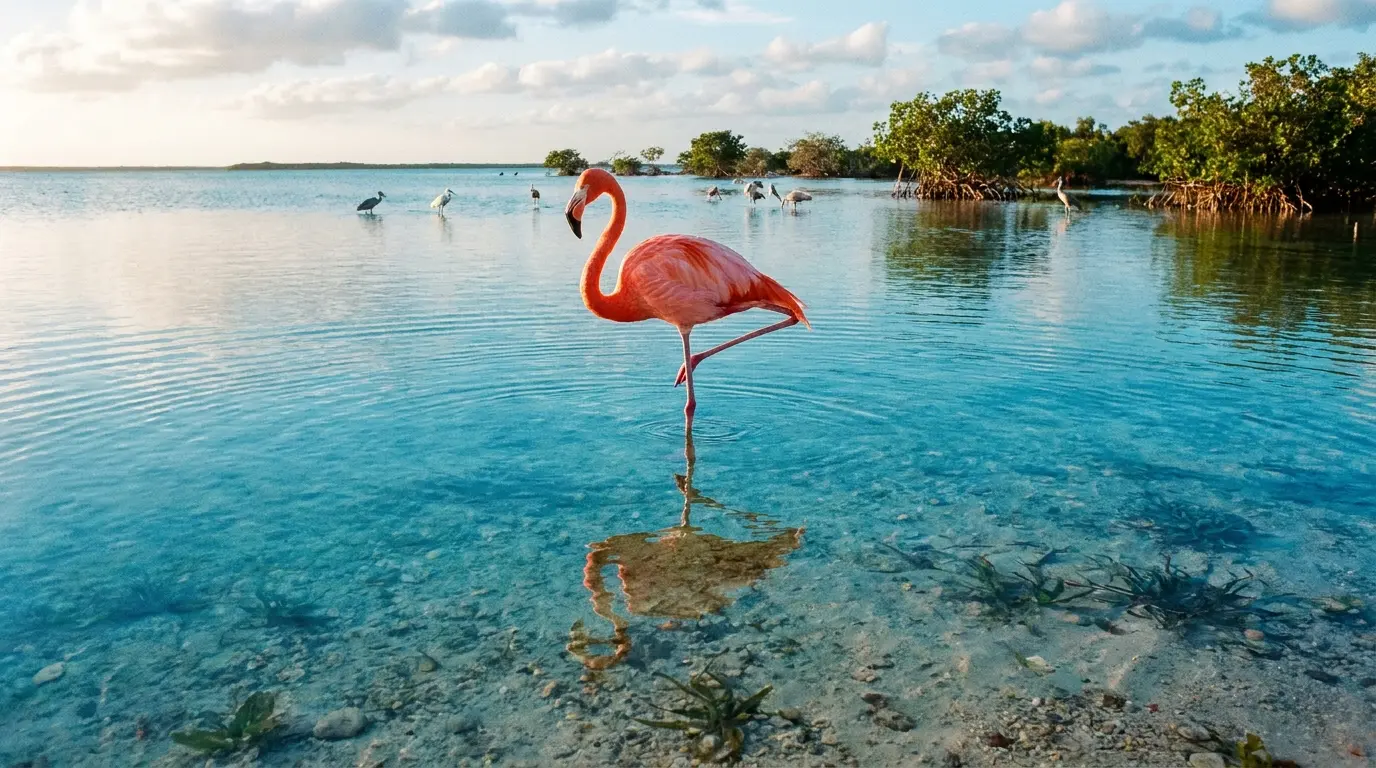
Flamingos are some of the most recognizable birds on Earth. Their bright pink feathers, long curved necks and skinny legs make them look almost unreal. But the thing people notice most is how they stand: perfectly balanced on one leg, sometimes for hours, even while sleeping. So why do flamingos stand on one leg?
For years, this was one of nature’s small mysteries. Try standing on one leg yourself and you will start to wobble within a minute. Yet flamingos make it look effortless. Thanks to some clever experiments, scientists now have two strong explanations. In this guide, we explain what the research says and share some amazing facts about these colorful birds.
Do all flamingos stand on one leg?
Yes, all six species of flamingo are known for standing on one leg. They do it while resting, preening and sleeping, and they often switch from one leg to the other. Many other birds, such as ducks, herons and storks, also rest on one leg, but flamingos are the most famous for it because of their long legs and eye-catching color.
Theory 1: Standing on one leg saves energy
The most exciting discovery came in 2017. Two scientists, Young-Hui Chang from the Georgia Institute of Technology and Lena Ting from Emory University, wanted to know whether flamingos use their muscles to balance on one leg, or whether their bodies are designed to do it automatically.
They studied live young flamingos and measured how much they swayed while standing. Surprisingly, the birds were steadier when they were asleep on one leg than when they were awake. That suggested balancing on one leg took very little effort.
Then the researchers tested flamingo bodies that had died from natural causes. Amazingly, these bodies could be positioned to stand on one leg without any support or muscle activity. They could not stay balanced on two legs in the same way.
The scientists concluded that flamingos have a built-in “passive” mechanism. When a flamingo lifts one leg and shifts its body weight over the other, its joints lock into a stable position. Gravity does most of the work, and the bird barely needs its muscles at all. For a flamingo, standing on one leg may actually be easier than standing on two.
Theory 2: Standing on one leg keeps them warm
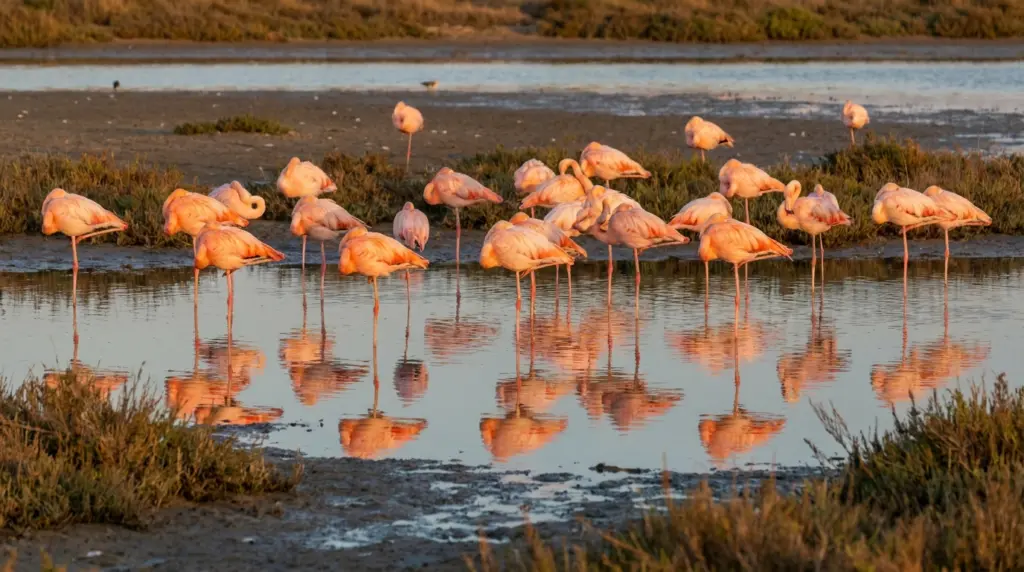
Flamingos spend much of their lives wading in water, which can be cold, especially at night. Water draws heat away from the body much faster than air. Their long, bare legs lose heat easily.
By tucking one leg up into their warm feathers, flamingos reduce the amount of skin exposed to cold water and air. A 2009 study by researchers at Saint Joseph’s University in Philadelphia observed captive flamingos and found that more birds stood on one leg when the temperature was lower, and that they were more likely to rest on one leg in water than on land.
Many scientists now believe both theories are true. Standing on one leg helps flamingos save energy and stay warm at the same time.
What about the “backwards knee”?
When you look at a flamingo, its leg seems to bend backwards in the middle. Many people think this is a knee that bends the wrong way. In fact, it is the flamingo’s ankle. The real knee is much higher up, hidden under the feathers close to the body.
The long part of the leg below the ankle is made of foot bones. In other words, flamingos are standing on their very long toes. This unusual design is part of what helps them lock their legs in place when balancing on one leg.
5 amazing flamingo facts
1. Flamingos are pink because of their food
Flamingos are not born pink. Chicks are grey or white. Their pink color comes from natural pigments called carotenoids found in the algae and tiny shrimp-like creatures they eat. The more of these pigments they eat, the brighter their feathers become. In zoos, flamingos are given special diets to keep their color.
2. They eat upside down
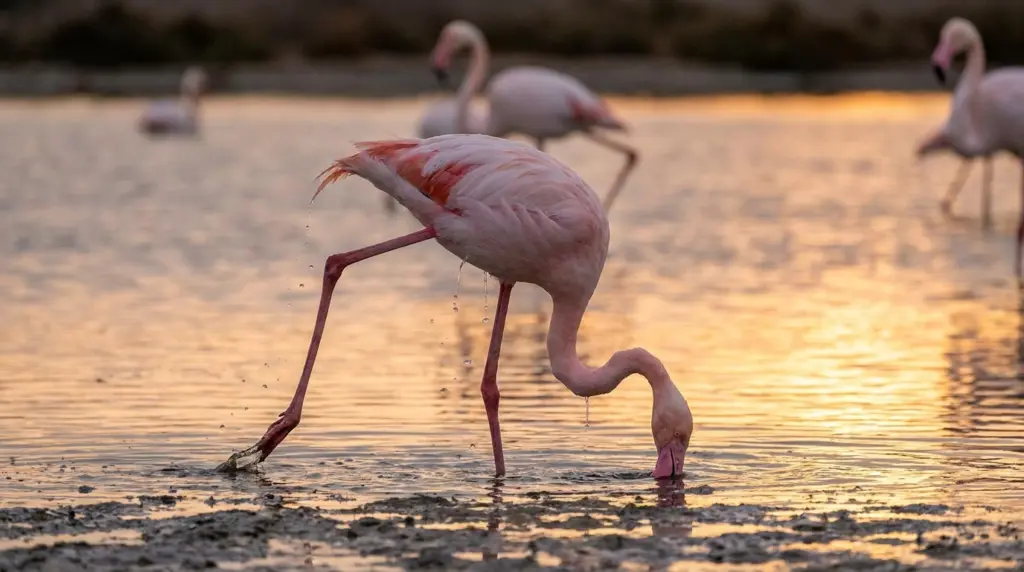
Flamingos feed with their heads upside down in the water. Their curved beaks act like filters. They scoop up water and mud, then use their tongue to pump it out through comb-like plates in their beaks, trapping tiny food particles inside.
3. A group of flamingos is called a flamboyance
The name could not be more perfect. Flamingos live in large groups, sometimes numbering thousands or even more than a million birds in places like the lakes of East Africa. Living in big groups helps protect them from predators.
4. They can live for decades
Flamingos are long-lived birds. In the wild they can live for several decades, and in zoos they often live even longer. A greater flamingo at Adelaide Zoo in Australia, simply known as “Greater,” was believed to be at least 83 years old when he died in 2014.
5. Flamingo parents share the work
Flamingo pairs build a mud nest together and take turns sitting on their single egg. After the chick hatches, both parents feed it a special red liquid called crop milk, made in their throats. Even male flamingos can produce it.
Do flamingos sleep standing on one leg?
Yes. Flamingos often sleep standing on one leg, with their heads tucked onto their backs. The 2017 research showed that they are actually more stable when asleep in this position. This lets them rest safely in shallow water, where many predators cannot easily reach them.
Can flamingos fall over?
It is rare. Their passive locking mechanism keeps them very stable. When they want to move, they simply unfold their raised leg and start walking. Flamingos can also run across the water to take off and fly, often in impressive V-shaped flocks.

Where do flamingos live?
Flamingos live in warm regions of the Americas, the Caribbean, Africa, southern Europe, the Middle East and parts of Asia. They prefer shallow lakes, lagoons, mudflats and salt pans, often in places that are too salty or alkaline for many other animals. These harsh habitats are full of the algae and tiny crustaceans flamingos love to eat, and they keep many predators away.
The lakes of East Africa, such as Lake Natron and Lake Bogoria, are famous for enormous gatherings of lesser flamingos. In the Americas, the Caribbean flamingo is the brightest of all, with deep orange-pink feathers. In Europe, you can see greater flamingos in places like the Camargue in southern France and the coasts of Spain.
Are flamingos endangered?
Most flamingo species are not endangered, but some are under pressure. The Andean flamingo of South America is listed as vulnerable, and the lesser flamingo is considered near threatened. Their biggest threats include habitat loss, pollution, mining, water extraction and disturbance at their breeding sites.
Because flamingos often breed in only a few special places, problems at one lake can affect a huge part of the population. Protecting wetlands is one of the best ways to make sure future generations can still enjoy the sight of flamingos standing on one leg.
Why do flamingos stand on one leg? Final thoughts
So, why do flamingos stand on one leg? The best answer is that it helps them rest with very little effort while keeping warm. Their special leg anatomy lets their joints lock into place, so gravity does most of the work, and tucking one leg into their feathers helps them hold on to body heat.
What looks like a difficult balancing trick to us is actually one of the most comfortable ways for a flamingo to relax. Nature, once again, has found a clever solution.
If you enjoyed reading about amazing animal facts, you might also love our stories about the longest living animals on Earth and animals that mate for life.
Frequently asked questions
Why do flamingos stand on one leg?
Research suggests flamingos stand on one leg because it takes very little muscle effort thanks to a passive locking mechanism, and because it helps them keep warm.
Do flamingos sleep on one leg?
Yes. A 2017 study found flamingos are actually steadier when asleep on one leg than when awake.
Why are flamingos pink?
Flamingos get their pink color from carotenoid pigments in the algae and small crustaceans they eat. Chicks are born grey or white.
Do flamingo knees bend backwards?
No. The joint that seems to bend backwards is the ankle. The knee is higher up, hidden under the feathers.
What is a group of flamingos called?
A group of flamingos is called a flamboyance.
Watch a story or save this one
Tap the story for another quick fact, or pin this article to read again later.

You might also like
Want more? Browse all our Animals stories.